Navigation markers
Isolated danger mark
An isolated danger mark indicates an isolated area where a specific danger exists with safe waters all around. It could be a rock, a wreck, or a reef. Isolated danger marks are not always positioned centrally over a danger and it is therefore advisable to refer to a chart and not to pass too close.
Some examples of the isolated danger mark are on the Prince George Bank off Indented Head, Wooley’s Reef at Frankston and Eagle Rock in northern Western Port.
Top mark
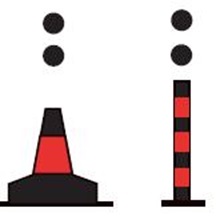
Isolated danger marks only ever display the one top mark; two black balls. It is the only navigation marker to use this top mark.
Colour scheme
This marker is coloured black at the top and the bottom, with red in the middle.
Light sequence
At night time, it will flash a white light in groups of two.
 Light sequence
Safe water mark
These are used to indicate that there is navigable water all around the mark. These marks can be used as a channel entrance, centre line, mid-channel, or landfall buoy. The Westernport Fairway buoy is a local example of this mark. As always, keep a lookout as large commercial vessels may pass close by these marks.
Topmark
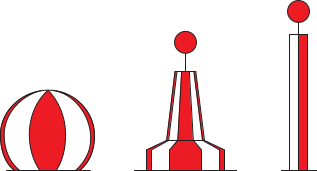
The topmark, which is fitted when practicable, is a single red sphere.
Colour scheme
A safe water mark can be a sphere, spar or pillar and is coloured with red and white vertical strips.
Light sequence
If lit, an isophase, occulting, one long flash every ten seconds, or morse ‘A’ (dot, dash) white light is exhibited. The buoy shape is optional but should not conflict with that used for a lateral or special mark.
 Light sequence
New danger mark
A new danger mark is used to display newly discovered hazards not yet shown in nautical documents. New dangers include naturally occurring obstructions such as sandbanks or rocks or man-made dangers such as wrecks.
New dangers may be marked using lateral, cardinal, isolated danger marks or by using the emergency wreck marking buoy. The mark may be removed when the new danger has been sufficiently communicated or otherwise resolved.
Topmark
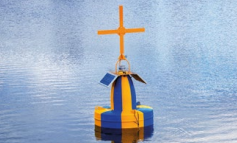
New danger marks may not always display a topmark, will display a yellow cross (plus sign) topmark.
Colour scheme
New danger marks are coloured with blue and yellow vertical stripes.
Light sequence
The light will occult to show alternate blue and yellow light; one second of blue light and one second of yellow light with half a second of darkness between.
 Light sequence
Special marks
These are used to indicate a special area or feature, the nature of which may be found by consulting a chart or sailing directions. Some local examples are the spoil ground, pipeline and recreation buoys in Port Phillip and the pilot buoy off Flinders in Western Port. In Victorian waters, special marks are commonly used to indicate no boating zones, special activity zones and speed restriction zones.
Topmark
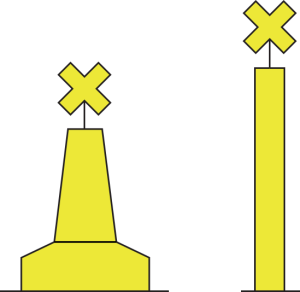
The top mark, if fitted, is a single yellow X.
Colour scheme
Special markers are always solid yellow in colour.
Light sequence
If a light is fitted it will be yellow and may have any rhythm not used for white lights.
Red Mini Buoy
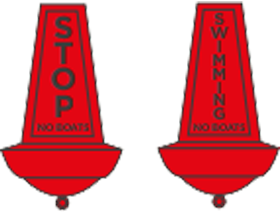
‘Stop – no boats’ or ‘Swimming – no boats’: used to mark prohibited water and swimming areas.
Green Mini Buoy
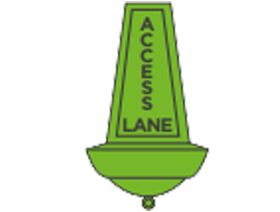
Access lane: the waters between these buoys are unrestricted to allow the picking up or dropping off of a water skier.
Yellow Mini Buoy

Speed restrictions: an area is set aside as a speed restriction zone because excessive speed is a risk to the operator, to other vessels or persons, or to the environment. The yellow buoys may be placed because of local or general requirements for slower speeds.
Red & Yellow Mini Buoy
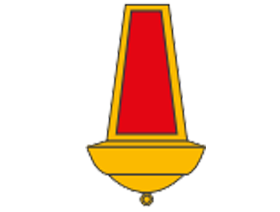
Special purpose: these unmarked buoys are used to signify things like regatta areas, hazards, channels.
Lead lights (leads)
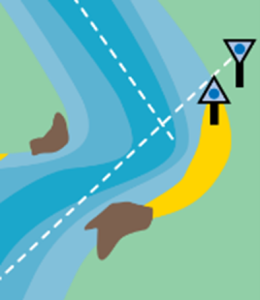
Leads are often used to guide vessels into a port or through sections of waterways. By moving your vessel so both leads are lined up, the course should be a safe one. Make yourself familiar with the area you intend to operate in before you head out.
Check local maps and charts for information concerning any leads that may exist in the area.
Boating zone marks and signage
Sometimes signs on the shore are used instead of, or in addition to, marks in the water. Examples of boating signs include “No boating zone”, “special purpose zone” or prohibited zone”.
Attempting the licence exam
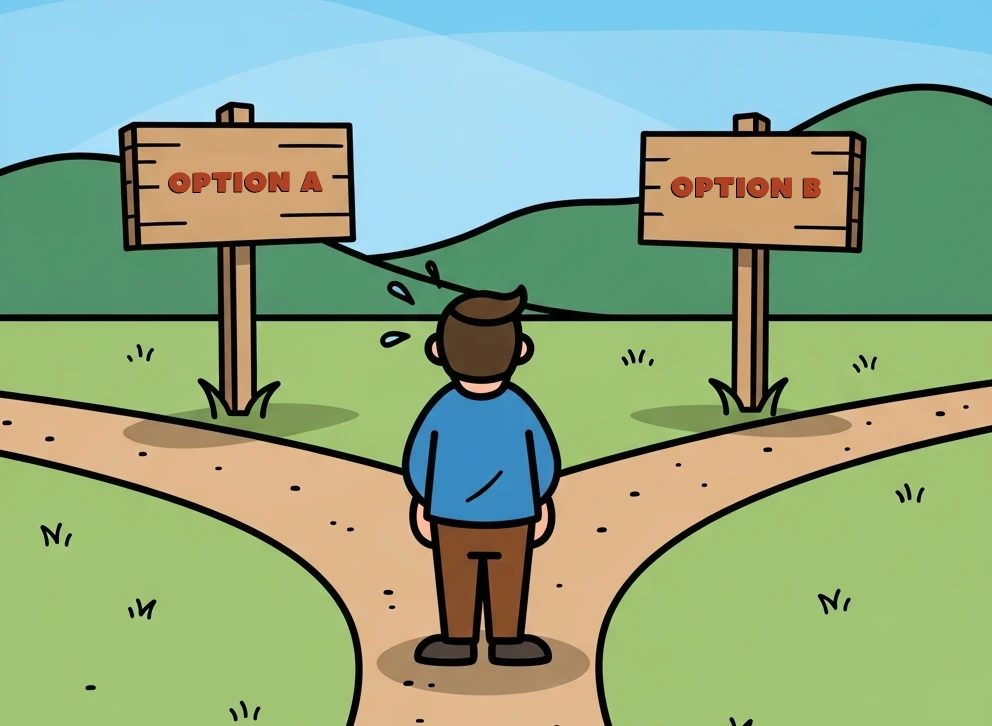
Option A
VicRoads testing: Simply turn up to any VicRoads centre in Victoria for instant licence testing. You can do this anytime, using this course to get the knowledge to smash the test. Immediately get your licence. It’s common for students to take Option A as it is a faster option.
To fast-track straight to the Option A practice exam, click here.
Option B
Zoom revision + testing: Complete this full training course then attend the comprehensive meet and greet zoom revision and testing session, which will take about 2 hours after this course’s education. Certificate will be mailed to you so you can take it into VicRoads to purchase the licence.
For those seeking a deeper dive into maritime safety and responsibility, we offer an exclusive personalised Zoom revision & testing session (Option B). This 2 hour meet and greet experience allows you to meet your trainer, discuss complex case studies, and attempt the licence exam with us instead of VicRoads. It is the ideal choice for students who want to go beyond the basics and gain maximum educational value from their training.
Our personalised Zoom sessions offer a fantastic opportunity to connect with your trainer before you dive in to the licence exam. This 2-hour interactive meeting is designed for more than just a “meet and greet”; it’s your chance to revisit core course topics, ask specific questions, and share a passion for boating with an expert. By the end of the session, you’ll be able to sit the official licence exam. If you prefer, you also have the option to complete your testing at a VicRoads location, skipping this meeting.